Every day in Kenya, millions of plastic bottles are purchased, used, and discarded. To most consumers, the story of a bottle ends the moment it is thrown away. But in reality, that is where a much longer journey begins — a journey that involves thousands of people working across the recycling value chain.
Understanding this journey is important because it reveals a fundamental truth: while many businesses benefit from packaging placed on the market, the responsibility and cost of recovering that packaging has historically fallen on the shoulders of the recycling sector.
This is the story of what happens to a PET bottle after it is discarded.
1: The Consumer
The journey begins when a consumer purchases a beverage packaged in a PET plastic bottle. After use, the bottle is discarded. In most cases in Kenya, waste is mixed together rather than
separated at source, meaning recyclable materials are often mixed with organic waste and other contaminants.
At this point, the bottle has lost its immediate commercial value. Without intervention, it is likely to end up in a dumpsite, drainage system, or the environment.
2: The Waste Reclaimer (Picker)
The first person who restores value to that bottle is often a waste reclaimer.
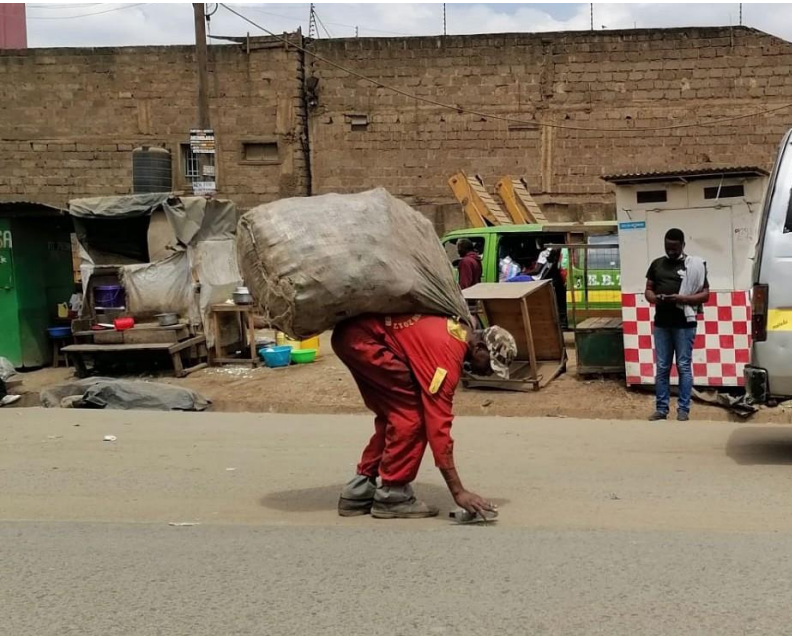
Across cities and towns in Kenya, thousands of informal waste collectors recover recyclable materials from households, streets, markets, and dumpsites. These workers manually identify, collect, and sort valuable materials such as PET bottles, aluminium cans, and paper.
Waste picking is physically demanding work that often takes place in difficult conditions. Yet waste pickers play a critical role in keeping recyclable materials within the economy rather than allowing them to become environmental pollution.
At this stage, the bottle begins its transition from waste to resource.
3: The Aggregator or Buy-Back Centre
Once collected, the bottle is sold to an aggregator or buy-back centre.
Aggregators play a vital role in the recycling ecosystem. They purchase recyclable materials from waste pickers, on unit kilogram basis, they segregate and consolidate volumes from multiple collectors, and perform preliminary sorting and storage, as well as primary processing for the few with space and equipment. Many aggregators operate micro enterprises that provide working capital to sustain material recovery activities.
This stage helps ensure that enough material is accumulated to make transportation to processing facilities economically viable.
4: Transport and Logistics
Recyclable materials must then be transported from aggregation centres to processing and value addition facilities.
In Kenya, recycling infrastructure is still developing, and processing plants may be located far from where materials are collected. This means recyclables often travel long distances before reaching a facility capable of processing them.
Transport costs, fuel, handling, and storage all contribute to the overall cost of recovering packaging materials.
5: Sorting and Pre-Processing
Before recycling can take place, materials must be sorted, cleaned, and prepared.
At this stage, recyclers remove contaminants, separate different types of plastics, and process materials through shredding or baling. Contamination and material losses are common, especially when waste has been mixed at the point of disposal.
These processes require equipment,space, labour, compliance and infrastructure, all of which involve significant investment.
6: Recycling and Manufacturing
Finally, the PET bottle reaches a recycling facility.
Here, it is processed into plastic flakes or pellets that can be used as secondary raw material in manufacturing. These recycled materials can then be used to produce new products such as packaging, textiles, or other plastic goods.
At this point, the bottle has completed its transformation from waste into a valuable input for industry.
Who Bears the Cost of This Journey?
While the recycling value chain generates economic value, it also carries substantial costs.
In Kenya today, many of these costs are absorbed by:
- Waste pickers through labour-intensive collection work
- Small aggregators through working capital and market risks
- Processing and Recycling enterprises through investments in equipment, logistics, and processing
Yet the packaging that ultimately becomes waste originates from products placed on the market by producers and brand owners.
Why Extended Producer Responsibility Matters
This imbalance is one of the reasons why many countries around the world have adopted Extended Producer Responsibility (EPR) policies.
EPR systems require producers to take responsibility for the end-of-life management of the packaging they introduce into the market. The goal is not to penalize producers but to ensure that the environmental cost of packaging is fairly shared across the value chain.
Globally, EPR fees typically represent a very small portion of product cost — often well below two percent of the retail price — while helping to finance systems that collect, sort, and recycle packaging materials.
Building a Fair Circular Economy
Kenya’s recycling sector already performs an essential environmental service by recovering valuable materials that would otherwise pollute the environment.
Strengthening this system requires collaboration across the value chain — from producers and policymakers to recyclers and consumers.
By recognizing the full journey of a PET bottle, we can better understand the importance of building systems that ensure packaging does not end its life as waste, but instead returns to the economy as a resource.
That is the essence of a circular economy.
Richard Kainika
Nairobi
March 2026


0 Comments